

After an accident, one of the first things you want to know is whether you’ll be able to recover financially from the costs of your injury, and it’s rarely a simple answer. Medical bills pile up, paychecks stop coming, treatment drags on, and the stress of it all adds up fast, leaving you unsure about what comes next. For injury victims in California, understanding the compensation options available is the first step to making a smart choice before accepting any settlement. This blog breaks down the types of compensation you could be entitled to, what affects how much you receive, and what to know before you move forward.
Compensation Overview at a GlanceRecovering from a workplace injury involves more than healing physically; it also means understanding the financial support available. California workers’ compensation may provide coverage for medical treatment, temporary and permanent disability, job retraining, return-to-work assistance, and death benefits for eligible dependents. Knowing how these benefits work, when they apply, and when legal guidance may be needed can help injured workers protect their rights and pursue the full compensation available under California law. |
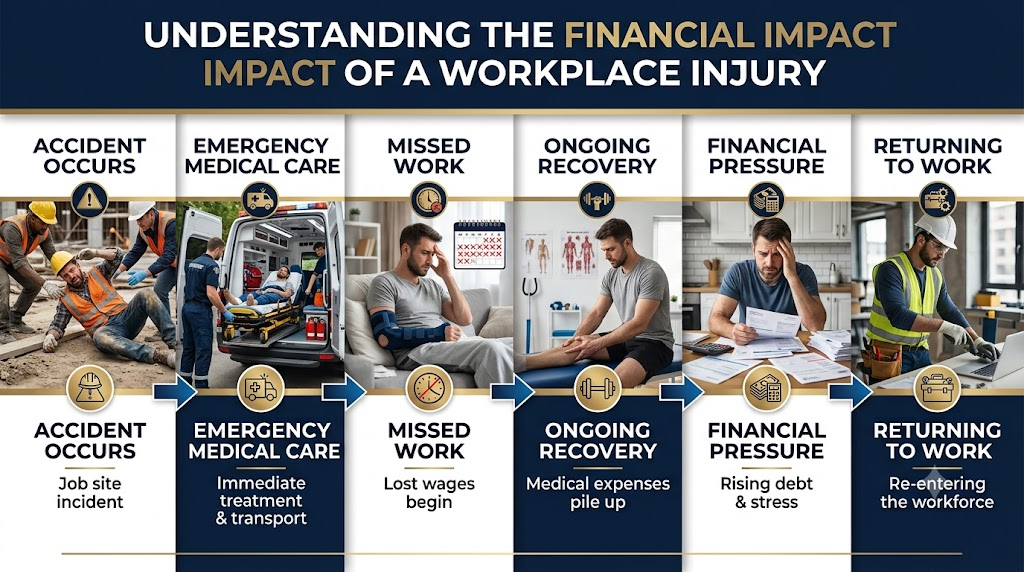
Understanding the Financial Impact of a Workplace Injury
A workplace injury costs more than just medical bills. Missed paychecks, ongoing treatment, and a disrupted income can hurt a household fast, so it helps to know what support is out there, how it works, and when it’s worth speaking with a workplace injury lawyer to make sure you’re not leaving money on the table.
|
Not sure what benefits you qualify for after a workplace injury? Get clear answers about your case before deciding what to do next! |
Workers’ Compensation Benefits for Job-Related Injuries
When it comes to California injury compensation for job-related accidents, workers’ comp is often the first and most direct path to financial recovery.
1. Medical Treatment Coverage
In California, your employer’s insurance must pay for any medical care you reasonably need to treat or recover from a work injury, based on the state’s approved medical treatment guidelines. Doctors and hospitals cannot bill you directly for a work-related injury, and treatment continues for as long as it’s medically necessary.
2. Temporary Disability (TD) Payments
A job injury that keeps you from working triggers wage-replacement payments called TD. Rates are set by the state each year. In 2026, that’s two-thirds of your normal weekly pay, capped at $1,764.11 a week, with a floor of $264.61 even if your regular pay is lower. Payments run until you return to work or your doctor determines you’ve reached maximum recovery.
3. Permanent Disability (PD) Payments
A work injury with lasting effects entitles you to weekly PD payments, calculated using the state’s disability rating system. In 2026, these typically range from $160 to $290, or $240 to $435 if your disability rating is 70% or higher. A 100% rating brings lifetime payments.
4. Supplemental Job Displacement Benefit (SJDB)
When a work injury keeps you from returning to your old role and your employer has no suitable alternative to offer, this voucher steps in to fill that gap. It’s worth up to $6,000 and covers retraining classes, books, licensing fees, and up to $600 for resume help or job placement. Use it within two years of receiving it, since the voucher expires after that window closes. Unlike claims under California personal injury law, this benefit doesn’t require proving fault, which is exactly why it exists as a safety net when a job simply can’t continue. If you’re unsure whether your situation calls for workers’ comp or a separate claim, personal injury lawyers can help clarify which path applies to your case.
5. Return-to-Work Supplement (RTWS)
Workers hurt on the job after January 1, 2013, who already hold an SJDB voucher can apply for an extra one-time payment of $5,000. The application window is one year from receiving your voucher, and approved payments typically arrive within 25 days.
6. Death Benefits for Dependents
Workplace injuries don’t only affect injury victims themselves; when a work injury or illness proves fatal, that loss reaches the people who depended on that worker. In those cases, the worker’s spouse, children, or other dependents can turn to this benefit for support. It covers up to $10,000 in burial costs [6], plus a cash payment starting at $250,000 for one dependent and rising to $320,000 for three or more.
Conclusion
Insurance companies expect injured workers to give up. Accident Defenders won’t let that happen. With over 30 years of combined experience, our attorneys have helped countless injured workers across Los Angeles and Southern California get the money they truly deserve, not just what an insurance company offers. We fight hard, we fight smart, and we don’t stop until you’re taken care of. Every case matters to us. Every client gets our full attention. And no insurance company can scare us into settling for less than you deserve.
|
Don’t wait to protect your future. Reach out today for a consultation, and let’s start fighting for the compensation you deserve! |
FAQ’s About Injury Compensation in California
1. Does a settlement affect my other benefits?
If you get money from both a lawsuit and workers’ comp for the same injury, you may have to pay some of it back. A lawyer can explain how this works.
2. Can I still recover compensation if I was partly at fault?
Yes. Even if the accident was partly your fault, you can still get paid in California. Your compensation just gets lowered based on how much you were to blame.
3. Is my injury settlement taxable in California?
Usually not. Money you get for a physical injury, including pain and suffering, is normally tax-free. But parts tied to lost wages or punitive damages might be taxed.
4. How long does it take to receive a settlement?
It depends on your case. Most settlements take a few weeks to about a year. If your case goes to court instead, it can take even longer.
5. What if the at-fault party doesn’t have insurance?
If the other driver has no insurance, your own uninsured motorist coverage can pay you instead, as if they had been insured. California insurers must offer this coverage to you.