
We often hear about people getting fired from their jobs unexpectedly. Unfortunately, not all of these terminations are done fairly by the employers. Since wrongful employment cessation can disrupt employees’ overall financial and emotional stability, the government has created specific rules to protect workers’ rights. So, having familiarity with those legal terms regarding wrongful termination is necessary because it helps you claim your compensation in court. But first, we need to go through some of the most common types of wrongful termination lawsuits and how they can protect you from unlawful practices by your employer. Let’s begin!
At a Glance: California’s Popular Kinds of Wrongful TerminationCalifornia is an at-will employment state, but employers cannot fire employees for illegal reasons. Wrongful termination claims commonly involve discrimination, harassment-related retaliation, medical or family leave violations, whistleblower retaliation, constructive discharge, breach of contract, and public policy violations. The deadlines range from 30 days to three years, depending on the claim. |
How Does California Law Protect You From Wrongful Termination?
1. Discrimination Lawsuits
Discrimination-based wrongful termination means being fired because of who you are, such as your race, age, or disability, not how you perform.
- How the law protects you: California’s Fair Employment and Housing Act (FEHA) bars employers with five or more employees from firing you for a protected trait, such as race, religion, sex, age (40+), or disability, even if another reason is given.
- What you can do: Save emails and reviews showing how you were treated. File a complaint with the California Civil Rights Department (CRD), the state agency, within three years, then sue within one year of its right-to-sue notice (permission to file in court). Federal claims go to the U.S. Equal Employment Opportunity Commission (EEOC) within 300 days.
2. Harassment and Retaliation for Reporting It
It happens when an employer fires you for reporting harassment, supporting a coworker’s complaint, or refusing to go along with it. The employer punishes the person who spoke up.
- How the law protects you: California’s Fair Employment and Housing Act (FEHA) prohibits harassment based on a protected trait at employers of any size. It also bars firing you for reporting it, including complaints made to a supervisor or HR.
- What you can do: Write down dates, what was said, witnesses, and who you told. Keep copies of written complaints. File with the California Civil Rights Department (CRD), the state agency, within three years to get the right-to-sue notice needed to file in court.
3. Medical and Family Leave (CFRA and FMLA)
Leave-related wrongful termination happens when an employer fires or retaliates against you for requesting or taking medical, family, or pregnancy leave you are entitled to.
- How the law protects you: The federal Family and Medical Leave Act (FMLA) covers employers with 50 or more employees. The California Family Rights Act (CFRA) covers employers with five or more employees. Eligible employees, generally with 12 months of service and 1,250 hours worked, get up to 12 weeks of job-protected leave in 12 months.
- What you can do: Keep your leave request, approval, and return-date messages. CFRA claims go through the California Civil Rights Department (CRD), the state agency. FMLA lawsuits generally must be filed within two years (three if the violation was willful).
4. Whistleblower and Other Retaliation
If your employer fires you for reporting illegal conduct or raising wage or safety concerns, then that is unlawful whistleblower retaliation.
- How the law protects you: California Labor Code 1102.5 prohibits firing you for reporting a reasonably believed legal violation to a government agency or a supervisor with authority to act, or for refusing to join illegal activity.
- What you can do: Document what you reported, to whom, and when. A lawsuit under Section 1102.5 generally has a three-year deadline. A retaliation complaint with the California Labor Commissioner, the state labor agency, generally must be filed within one year. Federal safety complaints to the Occupational Safety and Health Administration (OSHA) have a 30-day window.
|
Fired After Speaking Up About Unpaid Wages or Unsafe Conditions? Our employment attorneys can look at what you reported, who you told, and how soon after it you were let go. |
5. Constructive Discharge
Constructive discharge is one of the types of wrongful termination that happens when you resign because your employer made working conditions unbearable instead of firing you. The law can treat that forced resignation as a termination.
- How the law protects you: California treats it as a firing only when tied to an unlawful reason, such as discrimination or retaliation. Conditions must be so intolerable that a reasonable person would feel compelled to resign, and the employer created or knowingly allowed them.
- What you can do: You need to document each incident and report problems in writing before resigning, when possible. The deadline depends on the underlying claim, so speak with an employment attorney before you resign.
6. Breach of Contract
Now, a breach-of-contract termination happens when an employer fires you in violation of an agreement about how or why your job can end, whether written or implied by its policies and conduct.
- How the law protects you: Most California employment is at-will, meaning an employer can end it for any lawful reason. A contract promising a set term or termination only for good cause changes that, as can an implied agreement based on handbook policies, repeated job-security promises, or long service.
- What you can do: Gather your contract, offer letter, handbook, and written promises. The deadline is generally four years for written contracts and two for oral or implied ones. Damages are typically limited to lost wages and benefits. Check for an arbitration clause.
7. Wrongful Termination in Violation of Public Policy
This happens when an employer fires you for doing something the law protects, or for refusing to do something the law forbids. It applies even to at-will employees.
- How the law protects you: Known as a Tameny claim, it requires a public policy rooted in a statute or constitutional provision. Examples include being fired for refusing to break the law, filing a workers’ compensation claim, or serving on a jury.
- What you can do: Record the right you exercised or the illegal act you refused, and when you were fired. Damages can include lost wages and emotional distress, with a two-year deadline. Retaliation for a workers’ compensation claim (Labor Code 132a) must be raised with the Workers’ Compensation Appeals Board within one year.
What Compensation Is Available If Your Firing Was Illegal in California?
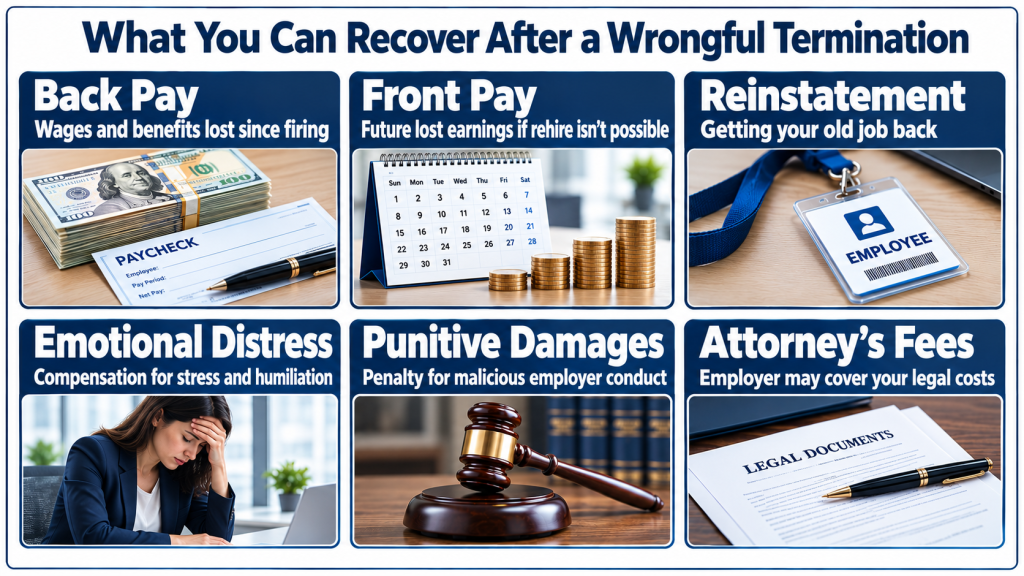
A successful claim can cover lost wages, future earnings, emotional harm, and even your legal costs, not just your last paycheck. The graphic below explains each one, but what you can receive depends on the type of claim you bring.
Other Factors to Know about Wrongful Termination Lawsuits
These factors are something you need to know when fighting legally against any of the above types of wrongful termination:
- The Burden of Proof: You (the employee) must prove the termination was wrongful.
- Documentation: To strengthen your claims, you need to collect and present clear evidence, like emails, recordings, and witness statements of the wrongful acts.
- Damages: You can seek compensation not just for lost wages but also for emotional distress.
- Time Limits: Strict deadlines exist to file a lawsuit; thus, taking action at the earliest is critical.
- Hire a Lawyer: Wrongful termination cases can be complex due to the various legal terms involved. To ease your case and raise the chances of a win, you might need to consult with a wrongful termination attorney.
Final Thoughts
By understanding the above rights, you can confidently claim compensation for your wrongful employment termination. Also, remember that based on the reason for your wrongful termination, report or file the case with the relevant authorities. If you are still unsure and need experts’ guidance regarding your scenario, you can consult with the team of experienced attorneys at Accident Defenders.
|
Your rights after an unfair firing deserve a knowledgeable advocate, not just a guess about what California employment law allows. |
FAQs About Wrongful Termination in California
1. Do I get my final paycheck right away if I’m wrongfully fired in California?
Yes. Your employer must pay wages, including unused vacation, the day you are fired. Late payment may add penalty pay.
2. Can I be fired for something I posted on social media outside work?
Yes, but not for protected posts. Some of that includes, political activity, talking about pay or working conditions, and reporting illegal conduct are protected.
3. How long does a wrongful termination case take in California?
Most cases settle within about six months to two years. However, cases that go to trial can take several more years.
4. Will I lose my health insurance if I’m fired wrongfully in California?
Not right away. The Consolidated Omnibus Budget Reconciliation Act (COBRA) or the California Continuation Benefits Replacement Act (Cal-COBRA) lets you keep your health plan for 18 months or longer, usually paying premiums yourself.
5. Can I get a copy of my personnel file after being fired?
Yes. Ask in writing; the employer must provide your personnel file within 30 days and payroll records within 21 days.