

As an employee, you might have lost your sleep over concerns about unfair firings, your boss withholding your pay, or rights you actually have. No need to worry because you aren’t alone in this; millions of people have gone through this, as such situations arise without warning and carry very serious consequences. Well, this is why employment law exists: it sets legal standards that employers must follow regarding wages, discrimination, and much more. It provides employees with real remedies when these standards are violated. But most workers are unaware of the full scope of these laws, which is why we have written this guide specifically for employees, to clear all the doubts. So come, let’s read into it!
Key Takeaways
- Employment law for workers
- Worker classification and legal status
- Wrongful termination protections
- Laws for discrimination at workplace
- Harassment and hostile work environments
- Rights against workplace harassment of employees
- Wage and overtime protections
- Employee misclassification issues
- Retaliation and whistleblower protections
- Family and medical leave rights
- Employee benefits and insurance protections
- Workplace safety and OSHA rights
- Employment contracts and agreements
- Non-compete and restrictive clauses
- Resolving employment disputes and legal claims
- Right time of legal Guidance
Who Does Employment Law Protect?
Covered Workers and Employment Status
- Full-time and part-time employees: If you are working as either of them, then, by most federal and state labor laws, you are covered.
- Temporary and hourly workers: Temp agency workers and hourly employees get federal protections under laws like the FLSA and Title VII, even when placed through third-party staffing firms.
- Misclassified independent contractors: Being a worker labeled as a contractor but functioning as an employee with proper schedules, having equipment from the company, and direct supervisory control. Then you may legally qualify as an employee under federal standards.
Why classification matters for legal protections?
For your overtime pay, anti-discrimination protections, and employer-sponsored benefits, the employment status will matter. Also, misclassification is one of the most economically damaging violations workers face, so proper classification really matters!
Wrongful Termination and Unlawful Job Loss
When Termination Becomes Illegal
- At-will employment explained from an employee standpoint: Well, most U.S. states follow at-will employment, which means your employer can technically let you go at any time. However, “at-will” does not mean “for any reason at all.” Employers cannot terminate you for reasons that violate federal or state law, no matter what your employment agreement says.
- Exceptions that protect workers from unlawful termination include:
- Violating anti-discrimination laws.
- Retaliating against any employee if they have reported illegal conduct.
- Violating public policy, like jury duty, etc.
- Breaching of the written employment contract.
Common Scenarios for Wrongful Termination
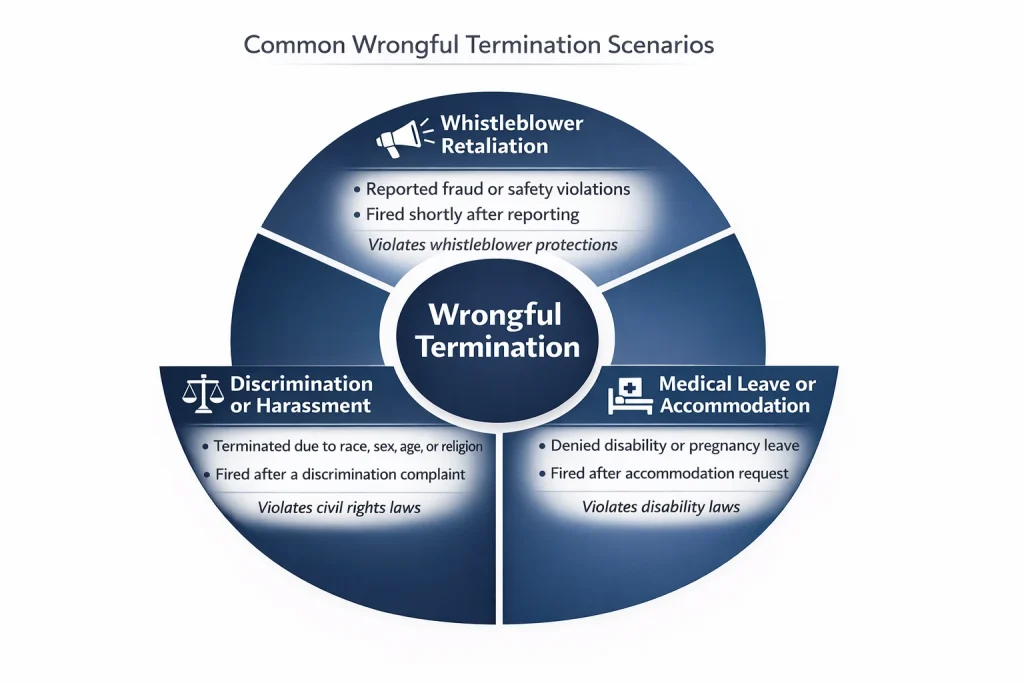
Need to know more about these scenarios? Have a look at our blog on 7 common types of wrongful termination lawsuits!
Also, many employees wonder what happens after a termination and whether they may still qualify for benefits. If you have similar concerns, you can also read our guide on wrongful termination: Do you get unemployment allowance if you’re fired in California?
Legal Remedies Available to Employees
- Lost wages and benefits: You will get your pay covering wages and benefits lost from the date of termination through judgment or settlement.
- Reinstatement or front pay: Courts also might order putting you back into the former position, but if it is impractical, like where it has become untenable, employees may instead receive front pay, compensating for projected future earnings.
- Compensation for mental stress: It affects not only your finances but also your psychological well-being. So, they may sought for non-economic damages in cases involving discrimination, harassment, or egregious employer conduct.
Workplace Discrimination Against Employees
Protected Employee Characteristics
- Race, gender, age, disability, religion, and national origin are all characteristics that are protected by the Federal law, mainly under Title VII of the Civil Rights Act, the ADA, and the ADEA. It is applied to all phases, like hiring, pay, and promotion.
- Pregnancy and family status protections, under the Pregnancy Discrimination Act prohibits any kind of wrong treatment based on pregnancy, childbirth, or related medical conditions. The PUMP Act and FMLA further protect expectant and new parents throughout their employment.
How Discrimination Appears at Work
- Hiring, promotion, and pay discrimination: When the workforce does not hire, promote, or pay fairly, it then counts as discrimination at work.
- Unequal job assignments or discipline: If you know that you are assigned tasks that are inferior to the skills you possess or strict discipline is expected from you, while others are treated more leniently. This means you are being discrmianted at work!
- Hostile work environments: Targeting someone regularly through insults, offensive jokes, and rude comments can create a hostile work environment, even if the person is not fired, demoted, or officially punished.
Employees who think they have been discriminated against should understand the full legal process involved. Our guide on the workplace discrimination lawsuit process takes you through how employees file discrimination claims step by step.
What Employees Can Do When Discrimination Occurs?
- Documenting incidents: You should start by maintaining a detailed written record of all discriminatory incidents that have occurred, including dates, who was involved, what was said or done, and any witnesses present.
- Internal complaints vs formal legal claims: Definitely, you should first file an internal complaint with HR, but it does not replace formal legal action. Employees have the right to legally file a charge of discrimination. Also, make sure you are filing discrimination claims before deadlines pass, as federal charges must typically be filed within 180 to 300 days of the discriminatory act.
Workplace Harassment and Hostile Environments
Sexual Harassment in the Workplace
- Quid pro quo harassment: In simple words, it means this for that. It occurs when a supervisor is telling an employee that they will only be promoted or able to continue to do their job if they agree to go on a date. It means an employee’s submission to sexual demands, which happens very commonly!
- Hostile environment harassment: A coworker who repeatedly makes objectionable comments about an employee’s appearance or body, even without any threatened job consequence, can create actionable hostile environment harassment.
If you need a little more understanding about this, you can read our blog in detail on what to do if sexually harassed at work, and all your queries will be sorted.
Non-Sexual Harassment
- Racial, age-based, and disability-based harassment: If in your workplace, the supervisor who consistently points out older employees with demeaning comments about being “too slow to keep up” may be engaging in age-based harassment that is actionable under the ADEA.
- Repeated conduct vs isolated incidents: As an employee, you need to make sure that sometimes a single offensive remark rarely rises to the level of illegal harassment. However, if there is a regular pattern, it establishes the “severe or pervasive” threshold required under federal law.
Employee Rights and Employer Responsibilities
The employee rights against harassment include:
- Free from being harassed in the workplace, regardless of who the harasser is, a supervisor, coworker, or client.
- Report harassment without any fear.
- Have their complaint taken seriously and investigated properly.
- Be protected from retaliation even if the underlying harassment claim is still under review.
Under the federal law, employers are legally obligated to maintain:
- Anti-harassment policies.
- Provide training.
- Take corrective action when harassment is reported to management.
They also have to take care that reporting harassment is a protected activity. Any adverse action taken against an employee for making a report, including demotion, schedule changes, or termination, constitutes illegal retaliation.
Wage and Hour Violations Affecting Employees
Unpaid Wages and Overtime Violations
- Failure to pay minimum wage: The federal minimum wage under the FLSA is $7.25 per hour. Some states (like California) have higher rates. Paying below the applicable minimum is a federal violation.
- Overtime pay denial: Non-exempt employees must receive 1.5 times their regular rate for all hours worked more than 40 in a workweek. Employers cannot waive this requirement or substitute comp time for overtime pay in private-sector employment.
Employee Misclassification Issues
- Independent contractor misclassification: Employers who term people under them as contractors to avoid payroll taxes and benefit obligations, while still controlling how, when, and where those workers perform their duties. Then this will be counted as violating both the FLSA and applicable state wage laws.
- Exempt vs non-exempt classification:
| Feature | Exempt Employees | Non-Exempt Employees |
|---|---|---|
| Pay Structure | Usually salaried | Usually hourly (some salaried) |
| Job Duties | Must meet executive, administrative, or professional duties tests | Do not meet the required duties tests |
| Overtime Eligibility | Not entitled to overtime pay | They will be provided with overtime pay |
| Overtime Rule | Salary generally covers all hours worked | Overtime required for hours over 40 per week |
Retaliation and Employee Whistleblower Protections
What Counts as Retaliation
Any materially adverse employment action taken because an employee was engaged in a legally protected activity, like:
- Filing a complaint
- Reporting a safety hazard
- Cooperating with a government investigation
Harassment after complaints
Subjecting an employee to increased scrutiny, hostility, or exclusion after a protected complaint is known as retaliatory harassment.
Protected Employee Activities
-
Reporting unsafe working conditions
Filing a complaint with OSHA or refusing to perform work that poses an imminent danger are federally protected activities under Section 11(c) of the OSH Act. These protections are especially relevant when considering what employees need to know about work restrictions following an on-the-job injury, as workers may be assigned tasks that exceed their medically approved limitations.
-
Complaining about wage theft or discrimination
Internal complaints to HR and external charges filed with the EEOC or Department of Labor are both protected activities. Retaliation against employees for either form of complaint is unlawful.
Legal Protection Against Retaliation
Remedies available to employees
- Job Reinstatement
- Punitive damages
- Legal fees recovery
Burden of proof considerations
But to establish retaliation:
- An employee must show they engaged in a protected activity
- The employer knew about it, and
- Adverse action followed
In this case, timing often matters significantly. An employer who terminates an employee days after a complaint faces a strong legal inference of retaliation, as the burden then shifts to the employer to state the reason for the action.
For employees whose workers’ compensation claims are challenged or denied, check our resource on what to do if a workers’ compensation claim is denied, which addresses both the appeals process and retaliation after filing a workers’ comp claim.
Family and Medical Leave Rights for Employees
Eligibility for Job-Protected Leave
The FMLA entitles eligible employees to up to 12 weeks of unpaid, job-protected leave per year for a serious health condition affecting the employee or an immediate family member, the birth or adoption of a child, or a qualifying military exigency.
Employer Violations of Leave Rights
It is very important that you understand employee rights during medical leave. Imagine you have a qualifying reason, and the leave is denied. Or your boss tells you to return before your protected leave period ends; both of these are direct FMLA violations.
Also, if the employer terminates or forces out an employee while they are on approved FMLA leave. Unless the employer can justify that the termination would have occurred regardless of the leave, the termination is unlawful interference with FMLA rights.
Employee Benefits and Benefit Denials
Health Insurance and Benefit Coverage Issues
- Improper denial of benefits: Employees enrolled in employer-sponsored health plans have rights under ERISA to receive plan documents and appeal for benefit denials. They can also seek judicial review if an appeal is improperly denied.
- Coverage termination disputes: Employers who terminate health coverage without providing the required Consolidated Omnibus Budget Reconciliation Act notice, which allows continuation of coverage after qualifying events, may face statutory penalties. Employees have 60 days to elect COBRA continuation and must be properly notified of that right.
Workplace Safety and Employee Protections
Employee Rights to a Safe Workplace
Under the OSH Act, employees have the right to a workplace free from recognized hazards, to request an OSHA inspection, and to review workplace injury logs. All your safety complaints can be filed directly at www.osha.gov/workers/file-complaint. They can also legally refuse to work if there is a reasonably belief that the job poses an imminent risk of death or serious physical harm.
Protection After Reporting Safety Concerns
Employees who experience retaliation for reporting safety hazards may file a whistleblower complaint with OSHA. If the agency finds merit, on behalf of employees, it can seek:
- Reinstatement
- Back pay
- Compensatory damages
Employment Agreements and Employee Obligations
Understanding Employment Contracts
Before signing, employees should carefully review:
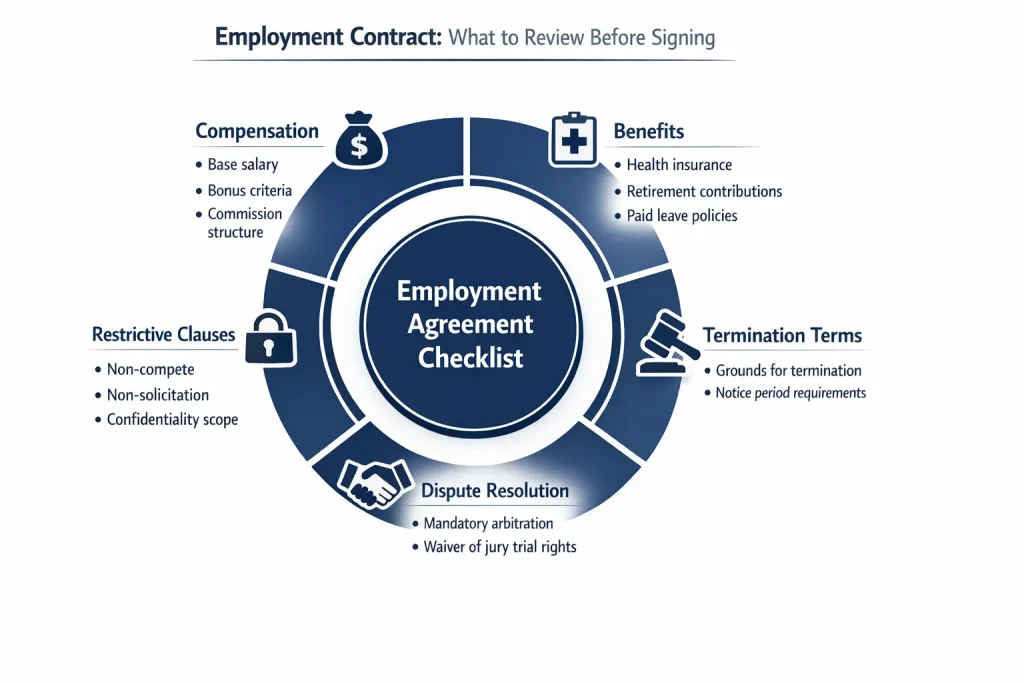
One thing to remember here is that not every part of a contract is automatically enforceable. Courts sometimes review certain contract terms very carefully. If a contract term goes against employee protection laws, it cannot be enforced, even if the employee signed the agreement.
The legal developments affecting workers’ rights continue to evolve, and you can check that in our biggest workers’ compensation stories of 2020, blog, which shows how courts and lawmakers regularly reassess protections for employees.
Non-Compete and Restrictive Agreements
- How these agreements affect employees: Non-compete clauses restrict employees from working for competitors or starting competing businesses for a defined period after leaving employment. It can significantly limit job mobility and bargaining power.
- When non-competes may be challenged: Non-competes may be unenforceable when they lack a legitimate business justification, are geographically or temporally overbroad, were signed without adequate consideration at the time of signing, or conflict with applicable state law. States, including California, ban them outright.
Severance Agreements and Employee Rights
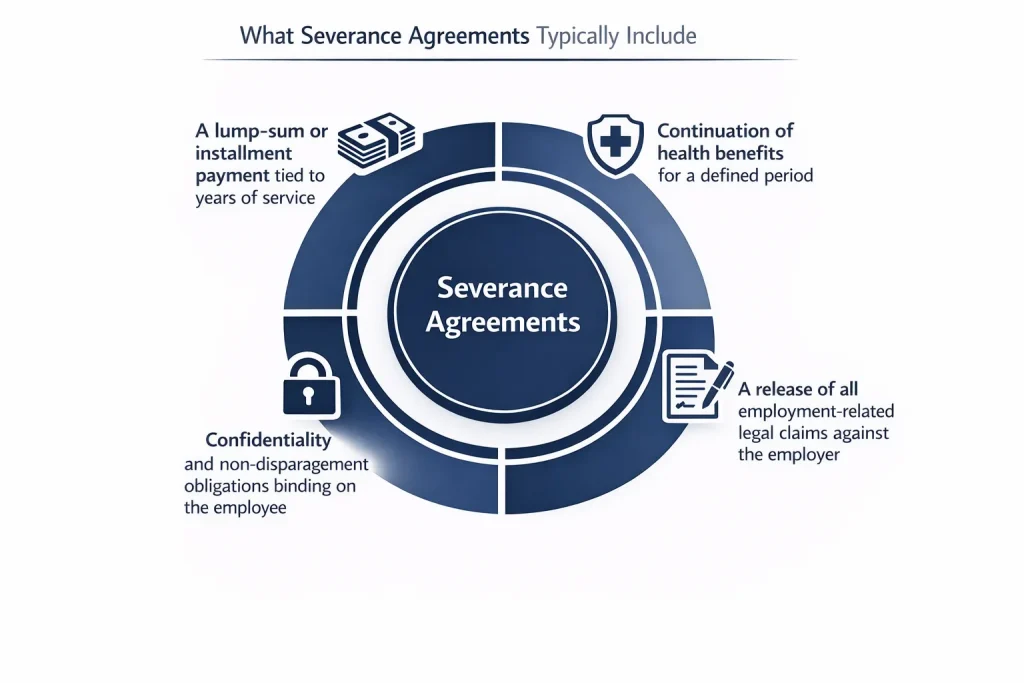
Severance terms can sometimes be negotiated depending on the situation. For example:
- If the employee may have a legal claim against the company, the employer might offer better severance to avoid a lawsuit.
- If the employee has special knowledge or important client relationships, the employer may negotiate to protect the business. Etc.
Resolving Employment Disputes as an Employee
Internal Complaints vs Legal Action
| Internal Complaints (When Appropriate) | Legal Action (When Necessary) |
|---|---|
| If something happens only once, or it is a misunderstanding or a workplace rule violation, it is usually best to first report it to HR. Often, the company can fix the problem once it knows about it | But if internal complaints are ignored, lead to retaliation, involve senior leadership, or reveal a pattern of ongoing violations, employees should consult an employment attorney. They should consider formal legal options before internal processes delay or weaken their claims. |
In situations where workplace harm also involves physical injury, medical documentation may become an important part of the case. For a deeper understanding, you can read our guide on the role of medical evidence in personal injury cases.
Administrative Claims and Legal Filings
Many employment claims must begin with an administrative charge. The:
- Discrimination and harassment claims go to the EEOC.
- Wage claims go to the Department of Labor’s Wage and Hour Division.
- Safety retaliation complaints are filed with OSHA.
Litigation and Settlement Outcomes
1. Employment litigation process typically involves:
- Administrative phase
- Potential right-to-sue letter issuance
- Discovery
- Motions practice, and
- In the majority of cases, a pre-trial settlement
The process can take 12 to 36 months or longer, depending on case complexity and the jurisdiction.
2. Settlement considerations
Most workplace disputes are settled before going to court. Employees should think about whether accepting a certain settlement now is better than trying for a larger award at trial, which can take time and be stressful.
When Employees Should Seek Legal Guidance
Early warning signs of legal violations
Sudden demotions, negative reviews after complaints, or cut hours after protected activity all make it for legal evaluation and not just a basic HR conversation.
Importance of preserving evidence
Always remember to save emails, pay stubs, performance reviews, and written policies outside employer-controlled systems immediately.
Understanding rights before signing or resigning
It is one of the basic things that never sign a severance, non-compete, or arbitration clause without consulting an employment attorney first.
If you still have any doubts, read our blog for a better understanding of when and how to hire a lawyer.
Conclusion
Hence, it is clear to you that acting early, preserving evidence, and consulting qualified legal counsel are the steps that must be followed as soon as possible. Now, if you are looking for legal aid for your problems, Accident Defenders will be there! We provide experienced legal guidance, case evaluation, and dedicated representation to help protect your rights and pursue fair compensation.
Get the justice you deserve!
Some Commonly Asked Doubts
1. When should I speak to an employment lawyer about a workplace issue?
The moment something feels legally wrong, contact the experienced employment attorneys at Accident Defenders. We are always there!
2. Will I be legally protected if I witness discrimination against a coworker and report it?
Yes. Third-party witnesses who report discrimination are protected against retaliation under Title VII.
3. Is my employer allowed to check my personal phone at work?
Employers cannot legally monitor personal devices without your prior consent.
4. Can my employer cut my pay without telling me in advance?
No. They need to notify you before reducing pay, as retroactive cuts are illegal.
5. Will my employer force me to work through a lunch break without paying me?
No. They can’t, in any break under 20 minutes where work is performed, be legally compensated.