

Losing your job is a stressful experience that leaves many workers in California feeling powerless. Moreover, many people believe “at-will” employment allows companies to do anything, but clear rules exist against discrimination and retaliation. You have specific wrongful termination legal options that prevent employers from firing you for illegal reasons. Identifying these wrongful termination legal options helps you understand if your employer broke state labor laws while offering you the benefits of financial recovery, professional accountability, and personal closure. You deserve to know the truth about your firing and the potential to reclaim your lost wages and stability.
This blog post explains the administrative steps, legal filings, and settlement pathways available to help you move forward after a sudden dismissal.
Key Overview of Post-Termination Legal Options
California employees have legal protections against wrongful termination despite at-will employment rules. After dismissal, workers should secure final wages, apply for unemployment benefits, review health insurance continuation, and obtain employment records. Claims involving discrimination, retaliation, or wage violations may be filed with agencies like the Civil Rights Department, EEOC, or Labor Commissioner. Documenting evidence, reviewing severance agreements, meeting legal deadlines, and pursuing lawsuits when necessary can help recover lost wages and enforce workplace accountability.
Government Agencies That Handle Termination Claims
The termination legal process often begins at the state or federal level before a private lawsuit is even allowed.
- Civil Rights Department (CRD): This agency investigates claims related to bias or harassment. Filing here is a mandatory step for most discrimination-based cases.
- Labor Commissioner’s Office: If your boss withheld your final paycheck or ignored overtime laws, this office handles the wage theft aspect of your exit.
- EEOC: This federal body oversees violations of the Civil Rights Act, providing an alternative route for those seeking justice under national standards.
California Job Termination: Legal & Administrative Steps to Take
Look, getting fired is stressful. But if it happened to you in California, there’s actually a lot you can do about it. Here’s what you need to know, step by step, on wrongful termination legal options.
Collect Your Final Paycheck Immediately
Here’s the thing: California doesn’t play around with this. The moment you’re terminated, your employer owes you that final paycheck right then and there. We’re talking all unpaid wages, any vacation or PTO you had stacked up, overtime, commissions, everything. And if they drag their feet? You can go after them for waiting time penalties. That could mean up to 30 days’ worth of your daily pay just for the delay. Also, double-check that your final pay stub actually breaks down every dollar they owe you.
File for Unemployment Benefits with the EDD
This one’s time-sensitive, so don’t sit on it. Head over to UI Online and get your unemployment claim filed with the California Employment Development Department right away. A lot of people think getting fired disqualifies them, but that’s not how it works. Unless you got terminated for something really serious, like willful misconduct, you’re probably still eligible for employment law remedies. Have your Social Security number, your employer’s info, and the reason for separation ready to go. Oh, and if they deny your claim? Appeal it. You’ve got 30 days, and honestly, a ton of denials get flipped during the appeal process.
Continue Health Insurance Through COBRA or Cal-COBRA
Do you know your health-related employee rights after termination? Well, just because you lost your job doesn’t mean your health coverage has to disappear overnight. If your company had 20 or more employees, federal COBRA lets you stay on your employer’s plan for up to 18 months. But California goes a step further with something called Cal-COBRA. It kicks in for employers with even just 2 employees and can stretch your coverage all the way up to 36 months. You’ll have about 60 days to decide if you want to opt in. Fair warning, though, you’ll be footing the entire premium yourself, plus a small admin charge on top.
Request Your Personnel File and Employment Records
Not a lot of people know this, but California Labor Code 1198.5 gives you the right to grab your full personnel file from your former employer. That covers everything: performance reviews, write-ups, attendance records, and anything you ever signed. All you have to do is send a written request to HR, and they’ve got 30 days to get it to you. Trust me, this stuff matters big time if you’re even slightly thinking about taking wrongful termination lawsuits down the road.
Evaluate and Negotiate a Severance Agreement
If they hand you a severance package during the exit, do yourself a favor and don’t sign anything right away. Most people don’t realize these things are negotiable and might affect their employee rights after termination. You can absolutely push for more money, longer health coverage, better reference terms, equity or stock considerations, and looser non-compete language. They usually give you somewhere between 7 and 21 days to think it over, so take that time. Get an employment lawyer to review the whole thing before you put your name on it. Once you sign, you’re almost certainly waiving your right to take them to court later.
File a Wrongful Termination Claim
Now, if you genuinely feel like your termination was illegal, California law has your back on this. There are a few common grounds on which people file wrongful termination claims. Discrimination tied to things like race, gender, age, disability, or sexual orientation is a big one. Retaliation is another, especially if you blew the whistle on something shady or filed a workers’ comp claim. Then there’s breach of contract, whether it was written or even verbal. And if they fired you for doing something totally legal, like showing up for jury duty or refusing to break the law, that falls under violation of public policy.
File Complaints with Government Agencies
You’ve got options when it comes to where you can take your complaint. The California Civil Rights Department handles discrimination, harassment, and retaliation cases. The EEOC covers federal-level discrimination issues. For wage theft or unpaid wages, it goes to the California Labor Commissioner’s Office. Got fired after calling out unsafe working conditions? That’s Cal-OSHA territory. And if your situation involves whistleblower protections, the U.S. Department of Labor is the place to go.
File a Wage Claim for Unpaid Compensation
Still waiting on wages, overtime, bonuses, or commissions your employer never paid? You can file a wage claim directly with the California Labor Commissioner’s Office, online, by email, or even in person. Make sure you’ve got your pay stubs, work schedules, and any other proof lined up. What happens next is they’ll schedule a settlement conference to try and work things out. If that doesn’t get you anywhere, it goes to a formal hearing where a decision is made.
Pursue Damages Through a Lawsuit
If your case is strong enough to go to court, a successful wrongful termination lawsuit can get you several types of compensation such as back pay covering all the wages you lost from the firing date to the resolution, front pay for projected future earnings, emotional distress damages for the psychological toll, punitive damages when the employer’s behavior was especially bad, reinstatement to get your old job back by court order, and injunctive relief forcing the employer to fix their unlawful practices.
Document Everything and Preserve Evidence
I can’t stress this enough: save everything. Your termination letter, every email and message between you and management, performance reviews, disciplinary records, and the names of coworkers who saw what happened. All of it. Don’t go deleting texts or clearing out your inbox. And whatever you do, if they put a document in front of you during that termination meeting, don’t sign it until you’ve had a wrongful termination lawyer look at it first. This kind of evidence can make or break your case later on.
Be Aware of Statutes of Limitations
Here’s the part a lot of people miss: every claim has a deadline attached to it. Depending on what you’re filing, you could have as little as six months or as much as three years. Discrimination complaints through the CRD usually give you a three-year window, which is decent. But the clock starts ticking the day you get fired, so the longer you wait, the fewer options you’ll have. Move quickly and keep your rights intact.
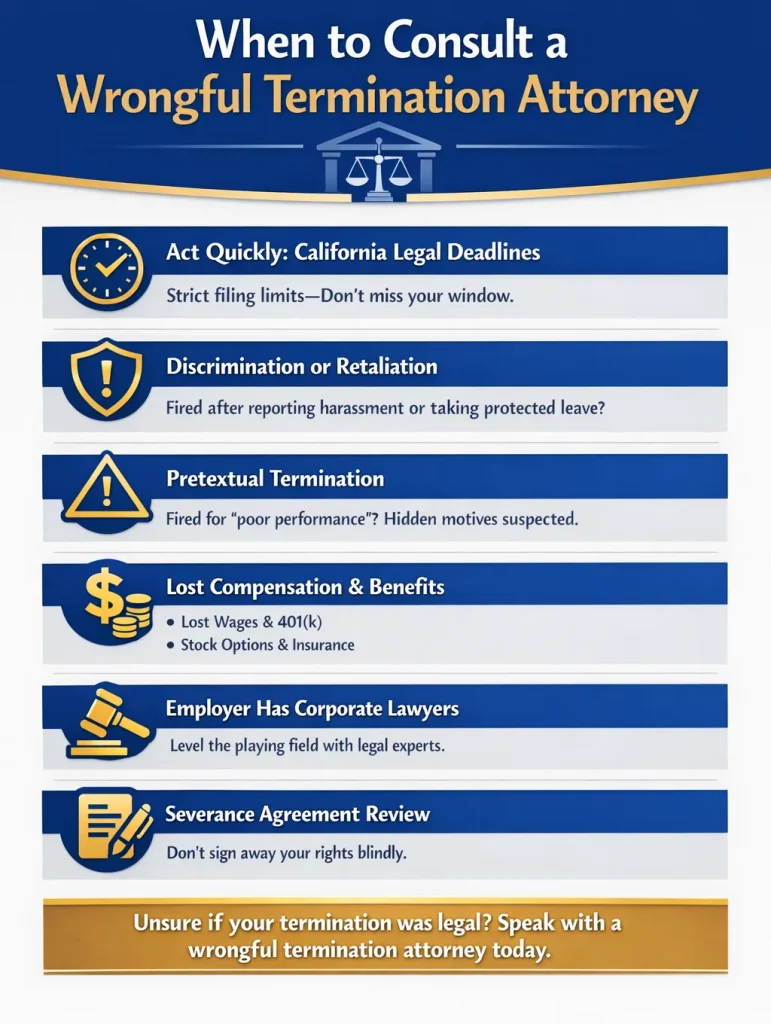
When to Consult a Wrongful Termination Attorney
Conclusion
Remember, standing up for your rights doesn’t just help you; it ensures that California workplaces remain fair and accountable for everyone. Were you terminated from your position without an adequate reason? It is time to fight back against injustice. Seeking assistance from experienced wrongful termination lawyers in Los Angeles, like Accident Defenders, helps you navigate these complex laws with ease. Our firm specializes in employment law; we help you pursue your legal rights and hold dishonest employers accountable.
Contact us right away for a consultation to protect your future and claim what you are owed!
FAQs
1. Can I collect unemployment if I sue for wrongful termination?
Yes. Unemployment is a separate state benefit and does not block your right to pursue wrongful termination lawsuits. However, if your employer proves “misconduct” to deny your benefits, it could potentially complicate your legal arguments later.
2. What is the “Duty to Mitigate” after being fired?
California law requires you to actively look for a new, similar job to minimize your financial losses. If a court finds you didn’t try to find work, they may reduce the amount of back pay you can recover in a settlement.
3. Do I have to pay taxes on my settlement money?
Usually, yes. The IRS considers “back pay” as taxable wages, so you will likely receive a W-2 for that portion. Other damages, like emotional distress, are generally reported on a 1099 and are still considered taxable income.
4. Is my non-compete agreement actually enforceable?
Almost never. California has the nation’s strictest bans on non-compete clauses, making them void for nearly all employees. An employer trying to block you from working for a competitor is likely violating state law.
5. Can I be fired for refusing to sign a severance agreement?
Your employer can fire you at any time, but they cannot legally force you to sign away your employee rights after termination. If you refuse to sign because you are planning a lawsuit, they cannot use that refusal as a “legal” reason for your dismissal.
6. What happens if my boss lies about why I was fired?
If an employer gives a fake reason to hide a discriminatory motive, it is called a “pretext.” Proving this lie is a primary goal for any wrongful termination lawyer, as it often serves as the strongest evidence of an illegal firing.
7. How long do I have to keep my health insurance?
Under Cal-COBRA, workers at small California companies (2–19 employees) can often keep their health coverage for up to 36 months. You must elect this coverage within 60 days of being notified, though you are responsible for the full premium costs.